Shopify named Fabrikatör one of the best demand forecasting solutionsnamed us a top demand forecasting solutionRead it on the Shopify Blog

Navigating the POQ Formula: Optimize Production Order Quantities for eCommerce

Navigating the POQ Formula: Optimize Production Order Quantities for eCommerce

Quick answer: POQ has two common meanings in inventory planning. Production order quantity, the sense used in this article, is the batch size that minimizes setup plus holding cost when stock is produced or received gradually rather than all at once. Period order quantity is a replenishment method that groups demand into fixed ordering periods: you review on a set calendar and buy exactly what the next window needs, instead of triggering a purchase every time stock crosses a reorder point.

In business, either version answers only part of the buying decision. Before a real purchase order goes out you still have to weigh sales velocity, current stock, incoming purchase orders, supplier lead times, MOQs and batch sizes, and stockout risk. That is the job Fabrikatör does for growing ecommerce brands: turning those signals into a clear recommendation of what to reorder, how much, and when.

Are you struggling with inventory carrying costs for your eCommerce store? Optimized production order quantities (POQ) can significantly reduce inventory carrying costs. However, correcting the POQ calculation is vital to use it effectively in inventory management to meet demand without risking excess stock.

This blog breaks down the POQ formula with all the details you need. We’ll explore its impact on eCommerce stores, dive into the basics and advanced applications of POQ, and show you how to apply this formula for more profitable inventory management. Let’s start!

POQ Meaning and its Importance in eCommerce?

Production Order Quantity refers to the ideal quantity of products a business needs to order or produce simultaneously for maximum profitability. Calculating POQ helps businesses avoid overstocking, which leads to high inventory holding costs, and prevents stockouts, which can lead to low customer satisfaction.

For instance, a retailer that sells seasonal products can use production order quantities (POQ) to order the right inventory before a high-demand season, minimizing excess stock and maximizing profit.

📌 If you’re constantly having problems planning seasonal inventory, read Seasonal Demand Forecasting in eCommerce.

Understanding the Production Order Quantity Formula

The POQ formula defines how much a company should produce at a certain period.

Production Order Quantity (POQ) Formula for eCommerce stores.

Note that in this equation:

  • D = annual demand
  • S = setup costs
  • H = holding costs
  • d = daily demand
  • p = daily production

🔸 Example of calculating production order quantity with POQ formula

Suppose you run an eCommerce business selling eco-friendly water bottles. You operate 250 days per year, with an annual demand of 60,000 units. Your production facility can produce 1,800 units per day, and each production run has a setup cost of $100. Holding costs are $2 per unit annually.

To achieve a whole number, here are the adjusted variables:

  • Annual demand (D) = 60,000 units per year
  • Setup costs (S) = $100 per setup
  • Holding costs (H) = $2 per unit per year
  • Daily demand (d) = 240 units per day (60,000 units ÷ 250 days)
  • Daily production rate (p) = 1,800 units per day

Step-by-Step Calculation:

  1. Calculate the demand component in the numerator:
    • (2 * 60,000 * 100) = 12,000,000
  2. Calculate the holding cost adjustment in the denominator:
    • 1 – (240 / 1,800) = 1 – 0.1333 ≈ 0.8667
    • H * 0.8667 = 2 * 0.8667 = 1.7334
  3. Divide the demand component by the adjusted holding cost:
    • 12,000,000 ÷ 1.7334 ≈ 6,920,414
  4. Take the square root of the result to find POQ:
    • √6,920,414 ≈ 2,632 units

Calculating POQ is significant for your eCommerce store, but why exactly? How can you benefit from the production order quantity formula?

Benefits of Using the Production Order Quantity Formula in Production Planning

Using the Production Order Quantity (POQ) formula in eCommerce comes with several key benefits:

📉 Lower Inventory Costs with POQ

Using the Production Order Quantity (POQ) formula helps you avoid overstocking, meaning you only produce or order what you need. This reduces the costs associated with storing excess inventory, allowing you to free up valuable warehouse space and decrease storage expenses.

💰 Calculating Production Order Quantity Optimizes Capital Use

The POQ formula aligns your production levels with actual demand, minimizing the amount of capital in surplus inventory. Instead of having cash locked away in products that aren’t selling, you can invest those funds in other business areas, such as marketing or new product development.

⚙️ Efficient Resource Allocation with POQ Formula

With the POQ formula, you can streamline your manufacturing processes. By determining the ideal batch size to produce, you optimize your use of equipment, labor, and materials. This efficient allocation of resources helps prevent challenges in production and leads to faster turnaround times and better customer satisfaction.

As we explore the benefits of the Production Order Quantity formula, let’s compare it with other inventory management methods to see how it stacks up when optimizing your eCommerce operations.

Comparing POQ with Other Approaches

There are other ways to manage inventory other than using the POQ formula. These are:

🔹 Economic Order Quantity (EOQ)

The Economic Order Quantity (EOQ) model determines an optimal order quantity that minimizes the total cost of ordering and holding inventory. In contrast, EOQ assumes that the demand is constant and unsuitable for businesses with a fluctuating demand pattern.

🔹 Lot Sizing

Demand is used to group items into batches to do lot sizing. It is useful for businesses with changing production rates but carries a higher carrying cost than POQ. Generally speaking, EOQ and Lot Sizing can be used for companies with a predictable sales cycle, while POQ is ideal for an eCommerce operation needing agile inventory management.

🔹 POQ vs reorder point vs spreadsheets vs forecast-based replenishment

These four get talked about as alternatives, but they answer different halves of the same question. POQ sizes the order. The reorder point times it. A spreadsheet is where the maths gets done by hand. Forecast-based replenishment is the system that keeps both current as the numbers move.

ApproachHow the quantity is decidedWhat triggers the orderWhere it breaks down
POQ
Best fit: own production and contract manufacturing, where suppliers work in batches on long, fairly predictable lead times.
By formula. Production order quantity sizes a batch so setup plus holding cost is lowest when stock arrives gradually. Period order quantity sizes an order to cover a fixed number of weeks of demand.A fixed production or review calendar.It trusts the demand figure you feed it. If sales move mid-period, nothing notices until the next review.
Reorder point
Best fit: steady sellers with short lead times and suppliers who deliver when they say they will.
It does not size the order at all. It sets the trigger level: average daily sales multiplied by lead time, plus safety stock.On-hand stock falling to the trigger level.The trigger is static. It knows nothing about next week's promotion, a seasonal peak, or the purchase order already in transit.
Manual spreadsheets
Best fit: a small catalogue and one buyer who knows every SKU by heart.
However the planner works it out that week, usually from a sales and stock export.Someone remembering to open the file.It goes stale the day it is built, it does not survive a busy week, and the logic lives in one person's head.
Forecast-based replenishment
Best fit: growing catalogues where lead times, MOQs and seasonality differ by SKU and by supplier.
From a demand forecast per SKU, netted against current stock and incoming purchase orders, then fitted to supplier MOQs and batch sizes.Recalculated continuously, so the order date moves as sales velocity and lead times move.It needs clean sales history and honest lead times, and a planner still approves the purchase order.

Whichever one you use, the output has to be the same three answers: what to reorder, how much, and when. A formula gives you one of the three on the day you run it. A planning system keeps all three current as sales velocity, incoming stock and supplier lead times change.

While the Production Order Quantity (POQ) formula offers significant advantages in optimizing inventory, it's essential to consider the potential challenges in its implementation.

Challenges in Implementing the POQ Formula 🤔

While the POQ formula is useful for managing stock levels, it relies heavily on accurate demand forecasts. This can be tricky since market conditions shift rapidly, and seasonal demand often varies. For example, if you expect a surge in demand during a holiday season but don’t accurately predict it, you might end up with too much stock or out of stock and cannot meet the customer needs.

Additionally, setup or production cost fluctuations can impact the formula's effectiveness. If setup costs suddenly increase due to supply chain issues, the calculations may no longer reflect the best strategy for your business.

To tackle these challenges and optimize product orders, it's essential for businesses to regularly update their real-time demand data, make better inventory plans, and establish automated replenishment systems. Luckily, Fabrikatör does all of these for you in a very short time.

Optimize Production Orders with Fabrikatör! 🚀

Fabrikatör is an inventory planning solution designed for the increasing needs of your growing eCommerce store. It makes managing production orders easier with real-time inventory and automated inventory management processes, helping you keep stock levels optimal.
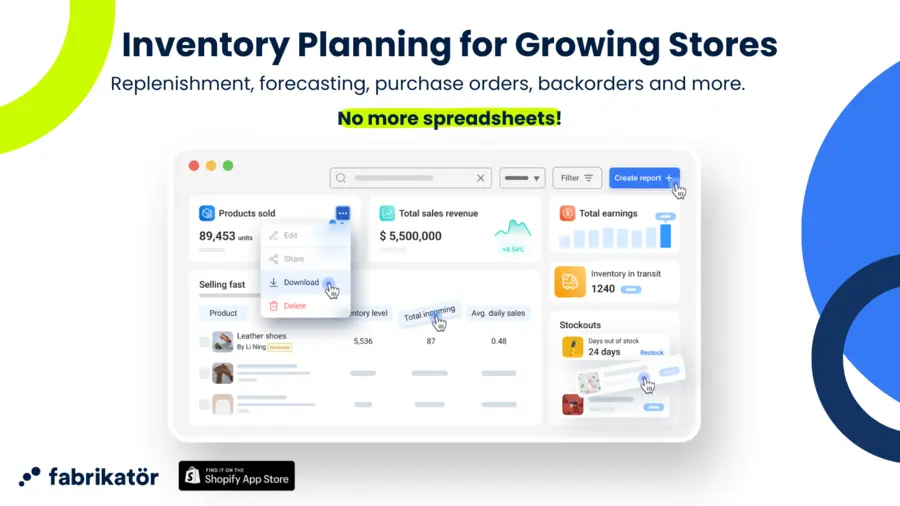
You can optimize production orders with Fabrikatör inventory planning solution

Fabrikatör optimizes production orders in several key ways:

  • 📊 Better Demand Forecasting: Fabrikatör uses historical sales data to provide accurate demand forecasts. This ensures you know what products to order, minimizing overstock and stockouts.
  • 📅 Long-term Inventory Plans**:** With Fabrikatör, you can leverage last year's inventory data to create realistic and growth-focused inventory plans for the upcoming period, aligning your purchasing decisions with market trends.
  • 🔄 Advanced Replenishment: Automating the replenishment process helps you maintain optimal stock levels without manual intervention. This means you can focus on sales rather than constantly monitoring inventory.
  • 🛒 Quick Purchase Orders: Fabrikatör enables fast purchase orders to keep your supply chain agile. You can reorder products with just a few clicks, ensuring you never run out of popular items.
  • 👀 High Inventory Visibility: Real-time insights into your inventory levels allow you to make informed purchasing decisions. This transparency helps you respond quickly to market changes and customer demands.

And much more!

In just 30 minutes, you can discover how Fabrikatör can transform the inventory management process and optimize production orders for your eCommerce store. See it in action and discover its benefits firsthand!

Want to see Fabrikatör in action?
Get a 30-minute free demo and see how Fabrikatör can improve your inventory operations.
Get a Demo

free newsletter

Newsletter Signup

Get the best in inventory management & Shopify in your inbox
Thank you!
Your submission has been received!
Oops! Something went wrong while submitting the form.

Navigating the POQ Formula: Optimize Production Order Quantities for eCommerce

Navigating the POQ Formula: Optimize Production Order Quantities for eCommerce

Quick answer: POQ has two common meanings in inventory planning. Production order quantity, the sense used in this article, is the batch size that minimizes setup plus holding cost when stock is produced or received gradually rather than all at once. Period order quantity is a replenishment method that groups demand into fixed ordering periods: you review on a set calendar and buy exactly what the next window needs, instead of triggering a purchase every time stock crosses a reorder point.

In business, either version answers only part of the buying decision. Before a real purchase order goes out you still have to weigh sales velocity, current stock, incoming purchase orders, supplier lead times, MOQs and batch sizes, and stockout risk. That is the job Fabrikatör does for growing ecommerce brands: turning those signals into a clear recommendation of what to reorder, how much, and when.

Are you struggling with inventory carrying costs for your eCommerce store? Optimized production order quantities (POQ) can significantly reduce inventory carrying costs. However, correcting the POQ calculation is vital to use it effectively in inventory management to meet demand without risking excess stock.

This blog breaks down the POQ formula with all the details you need. We’ll explore its impact on eCommerce stores, dive into the basics and advanced applications of POQ, and show you how to apply this formula for more profitable inventory management. Let’s start!

POQ Meaning and its Importance in eCommerce?

Production Order Quantity refers to the ideal quantity of products a business needs to order or produce simultaneously for maximum profitability. Calculating POQ helps businesses avoid overstocking, which leads to high inventory holding costs, and prevents stockouts, which can lead to low customer satisfaction.

For instance, a retailer that sells seasonal products can use production order quantities (POQ) to order the right inventory before a high-demand season, minimizing excess stock and maximizing profit.

📌 If you’re constantly having problems planning seasonal inventory, read Seasonal Demand Forecasting in eCommerce.

Understanding the Production Order Quantity Formula

The POQ formula defines how much a company should produce at a certain period.

Production Order Quantity (POQ) Formula for eCommerce stores.

Note that in this equation:

  • D = annual demand
  • S = setup costs
  • H = holding costs
  • d = daily demand
  • p = daily production

🔸 Example of calculating production order quantity with POQ formula

Suppose you run an eCommerce business selling eco-friendly water bottles. You operate 250 days per year, with an annual demand of 60,000 units. Your production facility can produce 1,800 units per day, and each production run has a setup cost of $100. Holding costs are $2 per unit annually.

To achieve a whole number, here are the adjusted variables:

  • Annual demand (D) = 60,000 units per year
  • Setup costs (S) = $100 per setup
  • Holding costs (H) = $2 per unit per year
  • Daily demand (d) = 240 units per day (60,000 units ÷ 250 days)
  • Daily production rate (p) = 1,800 units per day

Step-by-Step Calculation:

  1. Calculate the demand component in the numerator:
    • (2 * 60,000 * 100) = 12,000,000
  2. Calculate the holding cost adjustment in the denominator:
    • 1 – (240 / 1,800) = 1 – 0.1333 ≈ 0.8667
    • H * 0.8667 = 2 * 0.8667 = 1.7334
  3. Divide the demand component by the adjusted holding cost:
    • 12,000,000 ÷ 1.7334 ≈ 6,920,414
  4. Take the square root of the result to find POQ:
    • √6,920,414 ≈ 2,632 units

Calculating POQ is significant for your eCommerce store, but why exactly? How can you benefit from the production order quantity formula?

Benefits of Using the Production Order Quantity Formula in Production Planning

Using the Production Order Quantity (POQ) formula in eCommerce comes with several key benefits:

📉 Lower Inventory Costs with POQ

Using the Production Order Quantity (POQ) formula helps you avoid overstocking, meaning you only produce or order what you need. This reduces the costs associated with storing excess inventory, allowing you to free up valuable warehouse space and decrease storage expenses.

💰 Calculating Production Order Quantity Optimizes Capital Use

The POQ formula aligns your production levels with actual demand, minimizing the amount of capital in surplus inventory. Instead of having cash locked away in products that aren’t selling, you can invest those funds in other business areas, such as marketing or new product development.

⚙️ Efficient Resource Allocation with POQ Formula

With the POQ formula, you can streamline your manufacturing processes. By determining the ideal batch size to produce, you optimize your use of equipment, labor, and materials. This efficient allocation of resources helps prevent challenges in production and leads to faster turnaround times and better customer satisfaction.

As we explore the benefits of the Production Order Quantity formula, let’s compare it with other inventory management methods to see how it stacks up when optimizing your eCommerce operations.

Comparing POQ with Other Approaches

There are other ways to manage inventory other than using the POQ formula. These are:

🔹 Economic Order Quantity (EOQ)

The Economic Order Quantity (EOQ) model determines an optimal order quantity that minimizes the total cost of ordering and holding inventory. In contrast, EOQ assumes that the demand is constant and unsuitable for businesses with a fluctuating demand pattern.

🔹 Lot Sizing

Demand is used to group items into batches to do lot sizing. It is useful for businesses with changing production rates but carries a higher carrying cost than POQ. Generally speaking, EOQ and Lot Sizing can be used for companies with a predictable sales cycle, while POQ is ideal for an eCommerce operation needing agile inventory management.

🔹 POQ vs reorder point vs spreadsheets vs forecast-based replenishment

These four get talked about as alternatives, but they answer different halves of the same question. POQ sizes the order. The reorder point times it. A spreadsheet is where the maths gets done by hand. Forecast-based replenishment is the system that keeps both current as the numbers move.

ApproachHow the quantity is decidedWhat triggers the orderWhere it breaks down
POQ
Best fit: own production and contract manufacturing, where suppliers work in batches on long, fairly predictable lead times.
By formula. Production order quantity sizes a batch so setup plus holding cost is lowest when stock arrives gradually. Period order quantity sizes an order to cover a fixed number of weeks of demand.A fixed production or review calendar.It trusts the demand figure you feed it. If sales move mid-period, nothing notices until the next review.
Reorder point
Best fit: steady sellers with short lead times and suppliers who deliver when they say they will.
It does not size the order at all. It sets the trigger level: average daily sales multiplied by lead time, plus safety stock.On-hand stock falling to the trigger level.The trigger is static. It knows nothing about next week's promotion, a seasonal peak, or the purchase order already in transit.
Manual spreadsheets
Best fit: a small catalogue and one buyer who knows every SKU by heart.
However the planner works it out that week, usually from a sales and stock export.Someone remembering to open the file.It goes stale the day it is built, it does not survive a busy week, and the logic lives in one person's head.
Forecast-based replenishment
Best fit: growing catalogues where lead times, MOQs and seasonality differ by SKU and by supplier.
From a demand forecast per SKU, netted against current stock and incoming purchase orders, then fitted to supplier MOQs and batch sizes.Recalculated continuously, so the order date moves as sales velocity and lead times move.It needs clean sales history and honest lead times, and a planner still approves the purchase order.

Whichever one you use, the output has to be the same three answers: what to reorder, how much, and when. A formula gives you one of the three on the day you run it. A planning system keeps all three current as sales velocity, incoming stock and supplier lead times change.

While the Production Order Quantity (POQ) formula offers significant advantages in optimizing inventory, it's essential to consider the potential challenges in its implementation.

Challenges in Implementing the POQ Formula 🤔

While the POQ formula is useful for managing stock levels, it relies heavily on accurate demand forecasts. This can be tricky since market conditions shift rapidly, and seasonal demand often varies. For example, if you expect a surge in demand during a holiday season but don’t accurately predict it, you might end up with too much stock or out of stock and cannot meet the customer needs.

Additionally, setup or production cost fluctuations can impact the formula's effectiveness. If setup costs suddenly increase due to supply chain issues, the calculations may no longer reflect the best strategy for your business.

To tackle these challenges and optimize product orders, it's essential for businesses to regularly update their real-time demand data, make better inventory plans, and establish automated replenishment systems. Luckily, Fabrikatör does all of these for you in a very short time.

Optimize Production Orders with Fabrikatör! 🚀

Fabrikatör is an inventory planning solution designed for the increasing needs of your growing eCommerce store. It makes managing production orders easier with real-time inventory and automated inventory management processes, helping you keep stock levels optimal.

You can optimize production orders with Fabrikatör inventory planning solution

Fabrikatör optimizes production orders in several key ways:

  • 📊 Better Demand Forecasting: Fabrikatör uses historical sales data to provide accurate demand forecasts. This ensures you know what products to order, minimizing overstock and stockouts.
  • 📅 Long-term Inventory Plans**:** With Fabrikatör, you can leverage last year's inventory data to create realistic and growth-focused inventory plans for the upcoming period, aligning your purchasing decisions with market trends.
  • 🔄 Advanced Replenishment: Automating the replenishment process helps you maintain optimal stock levels without manual intervention. This means you can focus on sales rather than constantly monitoring inventory.
  • 🛒 Quick Purchase Orders: Fabrikatör enables fast purchase orders to keep your supply chain agile. You can reorder products with just a few clicks, ensuring you never run out of popular items.
  • 👀 High Inventory Visibility: Real-time insights into your inventory levels allow you to make informed purchasing decisions. This transparency helps you respond quickly to market changes and customer demands.

And much more!

In just 30 minutes, you can discover how Fabrikatör can transform the inventory management process and optimize production orders for your eCommerce store. See it in action and discover its benefits firsthand!

Want to see Fabrikatör in action?
Get a 30-minute free demo and see how Fabrikatör can improve your inventory operations.
GET a Demo

free newsletter

Newsletter Signup

Get the best in inventory management & Shopify in your inbox
Thank you!
Your submission has been received!
Oops! Something went wrong while submitting the form.

Inventory Planning

View More Posts

Want to see Fabrikatör in action?

Get a 30-minute free demo and see how Fabrikatör can improve your inventory operations.
GET a Demo